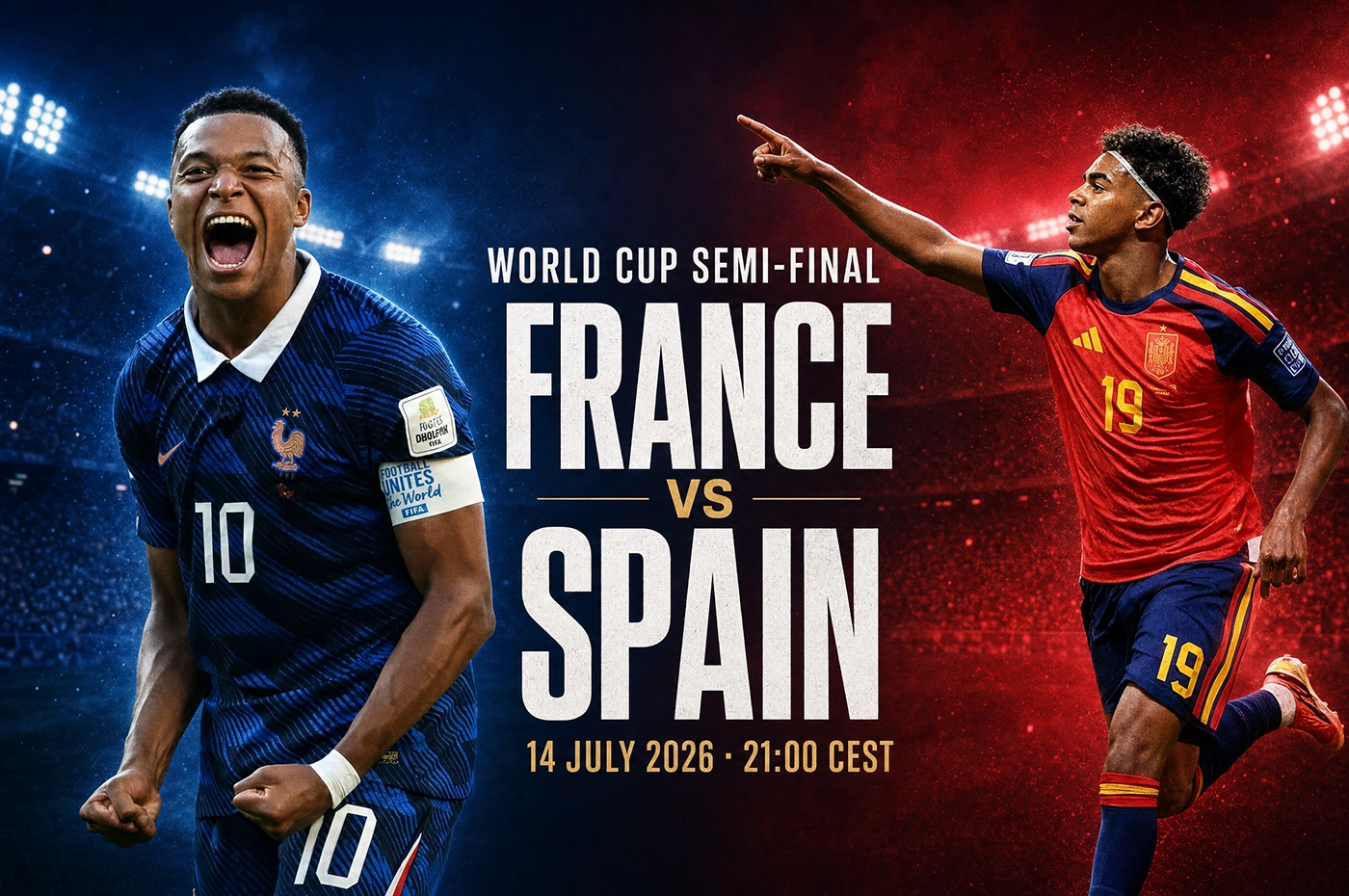
France have scored sixteen goals at this World Cup. Spain have conceded one. On Tuesday night in Dallas, one of those numbers stops being true.
This is the third time in three years that these teams have met in a semi-final. Spain won the first, at Euro 2024, with a Lamine Yamal goal that announced him to the world. Spain won the second, in the 2025 Nations League, in a five-four match that nobody who watched it will forget. France won the 2021 Nations League final before that. The ledger has swung back and forth, and the stakes have never been higher than they are now.
Didier Deschamps is managing his last tournament after fourteen years. A win takes France to a third consecutive World Cup final. Only Germany and Brazil have managed that. A loss ends his tenure one match earlier than he planned. Luis de la Fuente, by contrast, is building something that feels like the start of an era. Spain are unbeaten in thirty-six matches, excluding penalty shootouts. They have won nine of their last ten semi-finals across all competitions. The history tilts toward Spain. The form tilts toward France. The market has picked a side. I am not sure it has picked the right one.
PS3838 offers the sharpest lines on this fixture. Access them via AsianConnect88 →
France: Sixteen goals, six matches, zero interest in the ball
Kylian Mbappe has eight goals and three assists. Ousmane Dembele has five. Michael Olise has created five. The numbers are gaudy, but the mechanics behind them are what matter against Spain.
France does not need possession to score. Against Morocco, they had forty-eight percent of the ball and produced three-point-six-nine expected goals. Against Paraguay, they scored once from a penalty and spent the rest of the match probing a deep block without ever looking uncomfortable. The pattern is consistent. France is happy to let opponents pass sideways while they wait for the moment to strike. Their transition speed, from turnover to shot, is the fastest in the tournament. A ball won by Aurelien Tchouameni in midfield can be in the back of the net four seconds later.
Tchouameni returns after missing two matches with a thigh injury. His job is to win the ball and release it before Spain's press can organise. Adrien Rabiot plays next to him, carrying the ball through midfield lines with a rangy, upright stride that covers ground deceptively fast. Behind them, William Saliba and Dayot Upamecano have conceded two goals in six matches. Jules Kounde and Lucas Digne are full-backs who defend first and overlap second. France is not a team that only attacks. They absorb, they compress, they strike. It is not a philosophy. It is a mechanism. And it is calibrated for opponents who want the ball.
The question is whether France can remain dangerous without chasing the game. Spain will dominate possession. France knows that. Deschamps will set his team up to cede the ball and wait. If Mbappe gets three chances, he scores one. If Dembele gets four, he scores one. France does not need volume. It needs precision, and it has the players to deliver it.
Spain: One goal conceded, five clean sheets, and a question nobody is asking
Spain's defensive record is genuine. The single goal they have conceded, Charles De Ketelaere's header in the quarter-final against Belgium, came from a set piece after Thibaut Courtois had been forced off injured. No team has opened Spain up from open play in this tournament. The system, refined over two years under De la Fuente, controls matches by controlling the ball. Rodri anchors midfield. Pedri and Fabian Ruiz rotate around him. The full-backs push high, the centre-backs split wide, and the opposition spends the match reacting. Reacting is exhausting.
But there is a question nobody is asking: who have Spain actually defended against?
Cape Verde sat deep and played for a goalless draw. Saudi Arabia were overmatched. Uruguay played for a draw and got beaten by a single goal. Austria pressed and were dismantled. Portugal, with an aging Cristiano Ronaldo, created almost nothing from open play. Belgium scored from a set piece moments before losing Courtois to a thigh injury. None of these teams attack with the speed, the variety, and the individual quality that France brings. Spain's defensive numbers are elite. The sample they are drawn from is not.
Nico Williams is fit again and pushing for his first start of the tournament. His pace on the left gives Spain a different dimension, a runner who can stretch defences vertically rather than just shifting them horizontally. Lamine Yamal stays wide on the right, waiting for the moment to cut inside onto his left foot. Dani Olmo arrives late in the box. Mikel Merino, the substitute who has scored winners against Portugal and Belgium, arrives even later. Spain has goals in them. They just have not faced a defence like France's either.
The four-second match
This semi-final turns on a single question: can France's transition outrun Spain's recovery?
When Spain attacks, Pedro Porro and Marc Cucurella push into the opposing half. They are wingers in possession, not full-backs. Rodri drops between the centre-backs to form a back three. The system works because Spain rarely loses the ball in positions where it hurts them. Against France, they will lose the ball in those positions. Not often. Two or three times in the match. France only needs two or three times.
Mbappe starts on the left and drifts inside, occupying the space between right-back and right-sided centre-back. Dembele stays wide on the right, stretching the defence and pinning Cucurella deep. When France wins the ball, the first pass goes to Olise or Tchouameni. The second goes into the space behind Porro. If that second pass finds Mbappe, running at full speed against Pau Cubarsi, Spain's defensive structure becomes irrelevant. Speed beats shape. It always does.
Spain's countermeasure is Rodri. He must read the turnover before it happens, position his body between the ball and the runner, and buy the three seconds Porro and Cucurella need to retreat. If Rodri is fouling Rabiot thirty-five yards from his own goal, he is doing his job. If France completes the first forward pass after a turnover, Rodri has already lost. The midfield battle is the match within the match. Tchouameni and Rabiot bring physical power. Rodri and Pedri bring technical security. If France disrupts Spain's rhythm through the middle, with tactical fouls and shoulder-to-shoulder duels, Spain without rhythm is a different team. A slower team. A beatable one.
The other variable is the bench. Merino has scored twice as a substitute in this tournament, both times after the eighty-fifth minute. Desire Doue created the penalty that beat Paraguay after coming on. Both managers have players who can change the match from the sideline. If this is level after seventy minutes, the game opens up. Neither team wants extra time, and the substitutions will reflect that. Fresh legs against tired legs, in a semi-final where the stakes could not be higher, is a recipe for late drama.
Where the value sits
PS3838 have France at 2.430 to win in regulation, the draw at 3.180, and Spain at 3.250. The Asian Handicap sets France at -0.25 at 2.070 and Spain +0.25 at 1.840. The goals total has Over 2.5 at 1.909 and Under 2.5 at 1.980. These odds were captured on July 13, 2026, at approximately 21:00 CEST.
The 1X2 makes France the favourite. On paper, that is defensible. Mbappe is the best player in the tournament. France have scored sixteen goals. They are chasing a third straight World Cup final. But Spain have beaten France in back-to-back semi-finals. They are thirty-six matches unbeaten, excluding shootouts. They have conceded once in six matches. At 3.250, the market is pricing Spain as if none of those facts carry weight. I think they do.
The Asian Handicap tells a cleaner story. Spain +0.25 at 1.840 means a draw returns a half-win and a Spain victory returns a full win. In a match between two sides this evenly matched, at this stage of a tournament, a quarter-ball start is more valuable than the price acknowledges. Spain's path to this semi-final has been narrow. Two one-goal knockout wins. Two late goals from a midfielder who starts on the bench. But narrow paths do not mean the destination is undeserved. They mean the team knows how to win matches that stay tight. France's attack is the best Spain has faced by a distance, and Spain will concede chances they have not conceded against anyone else in this tournament. But Spain have also beaten this France team twice in two years. They know the patterns. They know the threat. They know they can win.
My pick is Spain +0.25 at 1.840 on PS3838. Not because Spain are the better team on paper. Because head-to-head history in semi-finals between these two sides points in one direction, because a quarter-ball head start in a match this tight should not trade at 1.840, and because Spain's defensive record, however soft the schedule that produced it, is the product of a system that knows how to survive the kind of chaos France creates.
PS3838 offers the sharpest World Cup lines across every market. If you are using a retail sportsbook for this match, check what price you are getting on Spain +0.25. The difference between 1.840 and whatever your book is offering is the cost of not having a PS3838 account.
Cian Murphy is a betting analyst and contributor at webetsmart. Read why he uses PS3838 →
Ready to bet this match? Open a PS3838 account via AsianConnect88 and access the same sharp lines Cian uses.
Odds referenced in this article were recorded for the original publication date and may no longer be available.