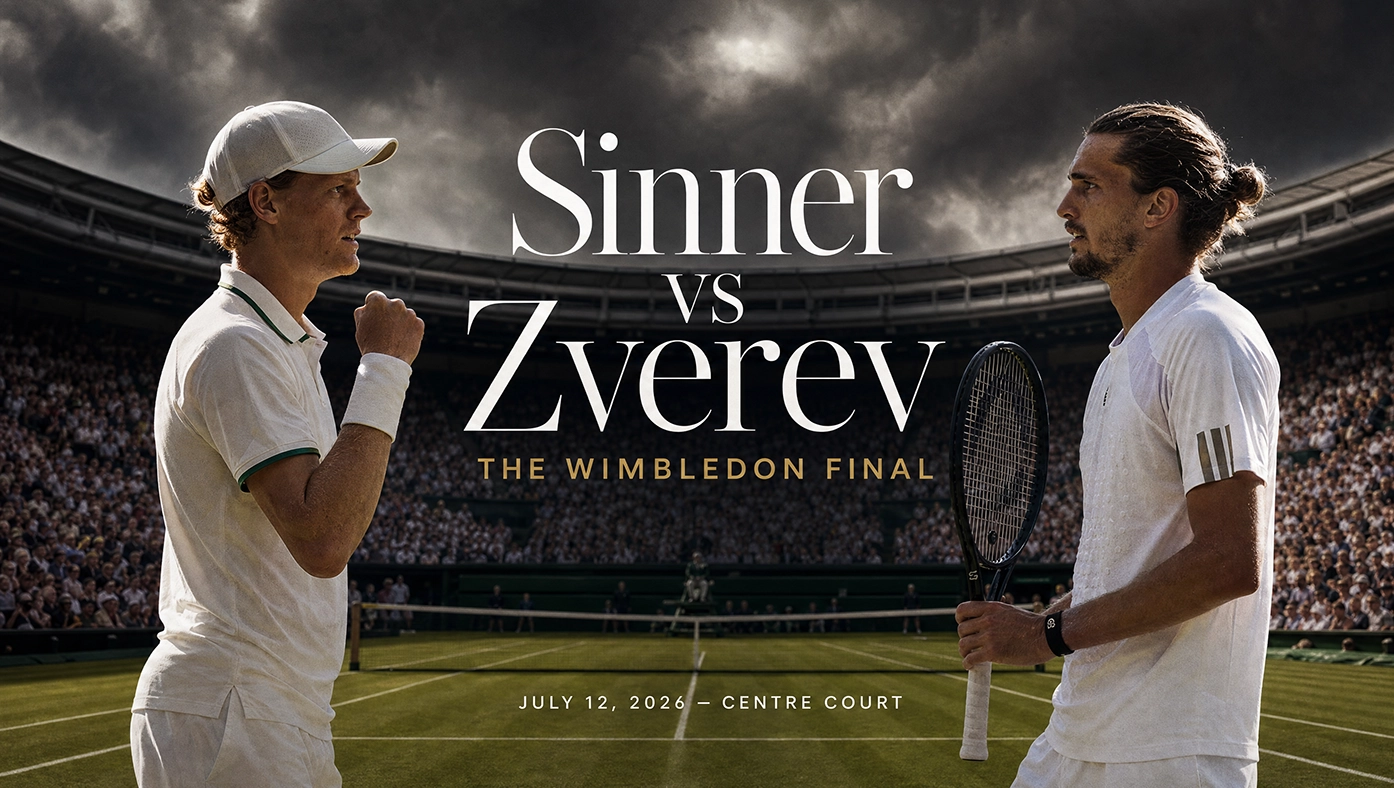
Jannik Sinner has beaten Alexander Zverev nine times in a row. He has won eighteen of their last nineteen sets. Their most recent meeting, the Madrid final seven weeks ago, lasted fifty-eight minutes. The score was six-one, six-two. It did not look like two of the best players in the world competing for a Masters title. It looked like a man who had solved a puzzle and another man who had stopped caring whether anyone noticed the pieces.
On Sunday afternoon, they meet on Centre Court for the Wimbledon title. The world number one against the world number two. The defending champion against the man who won his first Grand Slam five weeks ago in Paris. The surface is grass, and they have never played each other on it. That single fact, the one variable the fourteen prior meetings never had to account for, is what Alexander Zverev has left to cling to. It is thin. It is also real.
The market has priced a formality. On the evidence of nine straight defeats and a fifty-eight-minute clinic in Madrid, it has every reason to. But a grass court, a Centre Court final on the second Sunday, and a man who has lost five service games across six matches are all variables the head-to-head has never had to account for. The question is whether any of it changes the outcome. I think it changes the scoreline. Not the winner. Sinner wins this match. But the procession the market expects. I am not convinced the procession is coming.
PS3838 offers the sharpest lines on the Wimbledon final. Access them via AsianConnect88 →
The champion returning to the scene
Jannik Sinner is doing things that do not normally happen. He is thirty-seven and three in 2026. He has won five titles: Indian Wells, Miami, Monte-Carlo, Madrid, Rome. He became the second man in history, after Novak Djokovic, to complete the Career Golden Masters, winning all nine ATP Masters 1000 events. He is twenty-four years old and the world number one for seventy-two consecutive weeks. The numbers read like a misprint. They are not.
His semi-final against Djokovic was the performance of the tournament. Sinner won six-four, six-four, six-four. He hit sixteen aces. He did not hit a single double fault. He won eighty-eight per cent of first-serve points and faced one break point all match, which he saved with an ace. Djokovic, a seven-time Wimbledon champion and the most accomplished returner the sport has seen, won thirty-eight per cent of points behind his second serve and faced thirteen break points. Sinner did not beat him. He dismantled him. The match was not as close as the score suggests. Straight sets can lie. This one did.
Sinner leads the tournament with a hundred and thirteen aces. He has dropped one set all fortnight, the opener against Miomir Kecmanovic in the first round, a five-set scare that looks more like an aberration with every round he plays. Since that wobble, he has won eighteen consecutive sets. His grass-court record stands at twenty-nine and ten. His Wimbledon record, twenty-six and four through thirty matches, ties him with Borg, Becker, and Newcombe among the best starts in the Open Era at the All England Club. He is the defending champion. He is the best player in the world. He is the rightful favourite. None of that is in dispute.
The dispute is this: Sinner has never faced this version of Zverev. The Zverev who finally, after three lost Grand Slam finals, after a decade of being the best player never to win a major, broke through at Roland Garros. The Zverev who arrived at Wimbledon a different man. The Zverev who has lost his serve five times in six matches on a surface that was supposed to be his weakest. That Zverev is not the same player Sinner dismantled in Madrid. He might not be good enough to win on Sunday. He is good enough to make the scoreline honest.
The man who finally stopped knocking
Twelve months ago, Alexander Zverev lost in the first round of Wimbledon. He spoke openly about mental health struggles. He described loneliness on tour, the weight of expectation, the accumulating toll of falling short. He said he needed therapy. The quotes were raw. They read like a man who was not sure he wanted to keep doing this.
On Sunday, he will walk onto Centre Court as the French Open champion, the world number two, and the first German men's finalist at Wimbledon since Boris Becker in 1995. He is one win from becoming the seventh man in the Open Era to win Roland Garros and Wimbledon back to back, joining Laver, Borg, Federer, Nadal, Djokovic, and Alcaraz. That sentence is absurd. Twelve months ago, that sentence was unprintable.
The transformation has not been gradual. It has been binary. Before Roland Garros: the nearly man. After Roland Garros: a Grand Slam champion who suddenly knows how to win the matches he used to lose. The weight is gone. You can see it in his service motion, which is looser. You can see it in his forehand, which he is hitting harder and earlier than at any point in his career. You can see it in the scorelines. Five service games lost in six matches. Tiebreaks won: five out of five. The man who used to tighten on big points is playing them with the calm of someone who no longer needs to prove anything.
The numbers behind the run are remarkable. Zverev has not dropped a set since the fourth round. He beat Taylor Fritz, the sixth seed and a player who had beaten him seven straight times, in straight sets, six-four, six-four, six-two. He beat Arthur Fery, the British wildcard whose Centre Court run had captured the tournament, in straight sets, the first-set tiebreak a perfect seven-nil shutout. Fritz was the only seed he faced. The draw opened up for him after Carlos Alcaraz withdrew with a wrist injury. That is not Zverev's problem. You play who is in front of you. He has played everyone in front of him off the court.
And yet. The head-to-head is there. It is not a footnote. It is ten to four overall, nine straight for Sinner, eighteen of nineteen sets. The last time Zverev beat Sinner was August 2023, at the US Open. Sinner was not yet Sinner then. He had not won a Grand Slam. He had not ascended to world number one. The version of Sinner that Zverev has lost nine straight matches to is the version that exists now: the best player in the world, on the surface where he is the defending champion, in a matchup he has solved so completely that their last meeting looked less like a tennis match than a training drill. Zverev knows all of this. He also knows that none of their fourteen meetings were on grass.
What grass does to the equation
This is the tactical core of the match, and it is the reason I think the scoreline will be closer than the market does. Grass changes the serve-return equation more than any other surface. On clay and hard court, Sinner's return game is the best in the world. He reads serves early. He takes the ball on the rise. He turns neutral rally positions into offensive ones within two shots. On grass, the serve has more power. The ball skids. The returner has less time. Sinner will still break Zverev. He breaks everyone. But he will have fewer opportunities, and the windows will be narrower.
Zverev's serve on grass is a different weapon than Zverev's serve anywhere else. Five service games lost in six matches. That is not a good stat. It is an elite stat, the kind that wins Wimbledon titles. His first serve lands around sixty-five per cent of the time and wins north of seventy-five per cent of those points. His second serve, historically the shot that crumbles under pressure, has held firm. If he serves at that level on Sunday, he will hold. He will hold often. He will hold through tiebreaks. The question is whether he can hold enough to take a set, and at this level of serving, on this surface, the answer is almost certainly yes.
Sinner's path to victory runs through the return. He must pressure Zverev's second serve, the shot that has historically been the German's weakest link and the one Sinner has exploited most ruthlessly in their rivalry. He must keep his own service games short and clean, denying Zverev the rhythm and belief that come from return games won. He must handle the occasion, because defending a Wimbledon title, against a man with nothing to lose and a newly unburdened psyche, is a different kind of pressure than the one he faced beating Djokovic in the semi-final. Sinner is the better player. He is the rightful favourite. But a straight-sets dismissal of a man serving like Zverev, on a surface that rewards serves, in a Grand Slam final, is a bigger ask than the market seems to think.
The tiebreak looms over this match. Both men have been perfect in breakers this fortnight: Sinner three from three, Zverev five from five. Two elite servers, on grass, in a Wimbledon final. The first set will be tight. If Zverev steals it in a breaker, the Over three-point-five sets becomes close to a certainty. If Sinner takes it, Zverev still has the serve to level the match in the second. Either way, the path to under three-point-five, a Sinner straight-sets win, runs through a minimum of two tiebreaks, both of which Sinner must win. That is a narrow path. At two-point-two-four-zero, the market is pricing it wider than it is.
Where the value sits
PS3838 prices Sinner at 1.222 to win this match. Zverev is at 4.840. The set handicap has Sinner minus two and a half sets at 2.490, Zverev plus two and a half at 1.591. The total sets market has over three and a half at 1.714, under at 2.240. The games handicap sits at Sinner minus five at 1.943, Zverev plus five at 1.943, with the total games line at thirty-eight and a half, the over at 1.934 and the under at 1.952.
The moneyline is not wrong. Sinner at 1.222 reflects a player who has won nine straight against this opponent, eighteen of nineteen sets, and is the defending champion on a surface where his return game is the single most dominant force in the draw. There is no value in the favourite at that price. There is also no value in Zverev at 4.840, however tempting the redemption narrative. The head-to-head is too one-sided. The matchup problem is too deep. Nine straight losses are not a coincidence. They are a pattern, and patterns like that do not break just because the surface changes. Zverev might win a set. He might win two. He is not winning three.
The set total is where the value sits. Zverev has lost five service games in six matches on grass. He has won five of five tiebreaks. He is a Grand Slam champion playing with the freedom of a man who has already achieved the thing he spent a decade chasing. Sinner dropped a set to Kecmanovic in the first round and has been untouchable since, but Kecmanovic is not Zverev, and the first round is not a Grand Slam final. Two elite servers, on grass, in the biggest match of the fortnight. One of them has a matchup problem he has never solved. The other has never faced this version of his opponent on this surface. The market at 1.714 for over three and a half sets, implied probability fifty-eight point three per cent, is underestimating the chances of this match reaching a fourth set. I price the true probability closer to sixty-five per cent.
My pick is over three and a half sets at 1.714 on PS3838. Sinner wins this match. I am not arguing otherwise. The head-to-head is what it is, and what it is, is definitive. But Zverev's serve on grass, with a Grand Slam trophy already in the cabinet and the pressure redistributed, is good enough to take a set. It is probably good enough to take two. The under at 2.240 is pricing a straight-sets demolition, and I have watched too much of Zverev this fortnight to believe a demolition is the most likely outcome. At 1.714, the over is the sharper price.
The alternative position, for those who believe the matchup problem transcends surface, is Sinner minus five games at 1.943. If Sinner wins in straight sets, he covers five games with room to spare. If he wins in four, he probably covers. The risk is a fifth set, which would almost certainly push the total beyond thirty-eight and a half games and leave the minus five sweating. It is a purist's bet: you are betting that nine straight wins and eighteen of nineteen sets tell you more about this matchup than fourteen meetings on the wrong surface. I see the logic. I am just not sure grass lets you be that clean.
Cian Murphy is a betting analyst and contributor at webetsmart. Read why he uses PS3838 →
Ready to bet this match? Open a PS3838 account via AsianConnect88 and access the same sharp lines Cian uses.
Odds referenced in this article were recorded for the original publication date and may no longer be available.