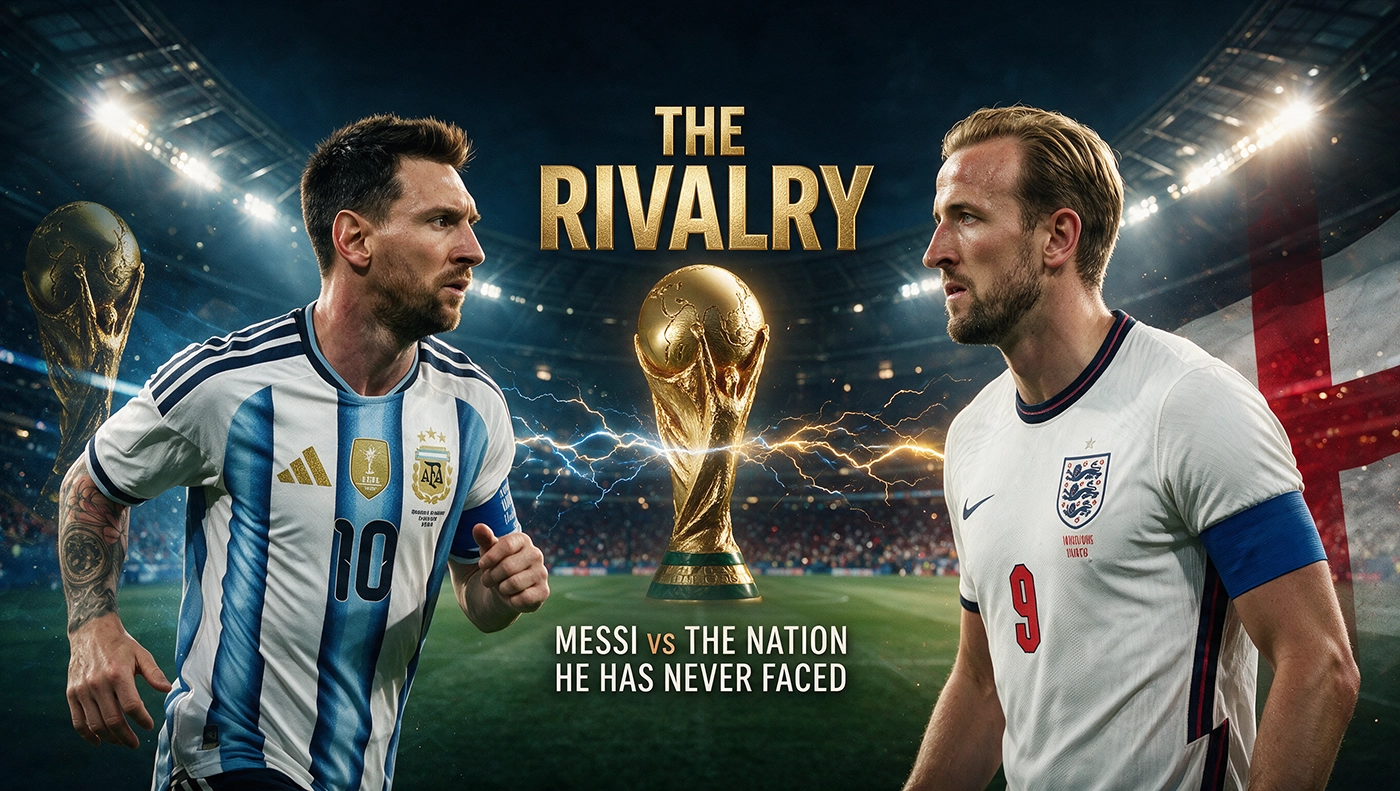
Lionel Messi has never played against England.
He is thirty-nine years old. He has won a World Cup, two Copas América, eight Ballons d'Or. He has played 191 times for Argentina, scored 115 goals, spent two decades rearranging what people thought was possible with a football. None of those 191 matches were against the nation his country considers its oldest football rival. Tonight, in Atlanta, that changes.
This is the sixth World Cup meeting between Argentina and England. The first since 2002. The first in a knockout round since David Beckham's red card and Argentina's penalty shootout win in Saint-Étienne, twenty-eight years ago. The history between these teams is not subtext. It is the text. Maradona's hand. Maradona's feet. Beckham's kick. Owen's run. The England players who lost that 1998 shootout are now pundits and coaches. They have been asked about it all week. The Argentina players who won it are national legends. Simeone, the man Beckham kicked, is the most famous Argentine football figure after Messi and Maradona. The history is alive. It breathes in every question asked at every press conference. Messi has never been part of it. Tonight he is the centre of it.
Argentina are the defending champions, chasing back-to-back World Cup titles. Only Italy and Brazil have done that. England are chasing a first final since 1966. The winner faces Spain on Sunday at MetLife Stadium. Thomas Tuchel has taken England further than any manager since Gareth Southgate in 2018. Lionel Scaloni has taken Argentina further than any manager since himself, four years ago. One of them goes home tomorrow. The other plays for a star on the shirt.
PS3838 offers the sharpest lines on this fixture. Access them via AsianConnect88 →
Argentina: Three extra times, eight Messi goals, and a question about the legs
Argentina have not won a knockout match in ninety minutes at this tournament.
Cape Verde took them to extra time in the Round of 32. Egypt led them 2-0 with fifteen minutes left in the Round of 16, and Argentina needed an Enzo Fernández winner in stoppage time. Switzerland dragged them to extra time again in the quarter-final, and only broke after Breel Embolo was sent off in the seventy-second minute. Argentina have played 390 minutes of knockout football in three matches. That is six and a half hours. For a squad with an average age north of twenty-nine, and a thirty-nine-year-old captain, that is not a footnote. It is the story.
Messi has eight goals in this tournament, tied with Kylian Mbappé for the Golden Boot. He took a blow to the right eye from Granit Xhaka in the quarter-final and missed training. He will play. He always plays. But the question is not whether he starts. The question is what he has left after sixty minutes. Against Switzerland, after Embolo's red card, Messi spent large stretches of the second half walking. Not disengaged. Conserving. He knew the match might go to extra time. It did. He found Julián Álvarez in the 112th minute. Álvarez scored from twenty-five yards. That is what Messi does now. He waits. He reads. He strikes. He does not need to run for ninety minutes. He needs two moments. Against England, two moments will have to be enough.
Scaloni is considering changes. The same XI has started four straight matches. Cristian Romero was substituted against Switzerland with exhaustion and is being assessed. Leandro Paredes has covered more ground than any Argentine midfielder at the tournament. Nahuel Molina may make way for Gonzalo Montiel at right-back. Nicolás González could come into midfield to add fresh legs. The decisions are not tactical. They are physical. Argentina are running on empty, and Scaloni knows it. The question is whether he trusts his best XI to push through one more time, or whether he gambles on freshness and hopes the system holds.
The defence has conceded in every knockout match. Two against Egypt. One against Switzerland. The clean sheet against Cape Verde required 120 minutes and an own goal from a Cape Verdean defender. Lisandro Martínez and Romero are elite centre-backs. The system around them has been less reliable. England will create chances. The question is whether Emiliano Martínez, the penalty shootout specialist, the man who won this tournament four years ago with his gloves and his mouth, can keep them out. The man thrives on this stage. He may have to.
England: Twelve goals, two men, and the Maradona parallel nobody wants to mention
Jude Bellingham and Harry Kane have scored twelve of England's thirteen goals at this World Cup. No other England player has scored more than once. That is a remarkable statistic. It is also a vulnerability. If Argentina can keep one of them quiet, England's goal threat halves. If they keep both quiet, England do not score. The equation is simple. The execution is not.
Bellingham is twenty-three and playing like the tournament belongs to him. He scored twice against Mexico in the Round of 16, with England down to ten men. He scored twice against Norway in the quarter-final, the equaliser and the extra-time winner. He is the first player since Diego Maradona in 1986 to score two or more goals in consecutive World Cup knockout matches. Maradona went on to win that tournament. Argentina do not need reminding. Bellingham drives England from deep, arriving in the box late, finding spaces that should not exist, finishing with the cold precision of a striker who has been doing this for a decade. His running power is the engine of this team. Stop Bellingham, you stop England. The problem is that nobody has stopped him yet.
Kane has six goals, tied with Gary Lineker for the most by an Englishman at a single World Cup. He was quiet against Norway. Bellingham carried that match. Kane does not need to dominate. He needs one chance. Against Mexico, he scored from a half-chance at the near post. Against DR Congo, he scored twice from three touches in the box. He is not the quickest forward in this tournament. He is the most efficient. His movement pulls defenders out of position. The ball finds him. It always does. England's route to goal is Bellingham carrying and Kane arriving. It has worked five times in six matches. Argentina have to find a way to break the chain.
Tuchel has built a team that defends in a compact 4-4-2 shape and attacks through vertical transitions. It is a system of moments, not passing patterns. Declan Rice screens the back four. Bellingham surges through the lines. Kane finishes. The simplicity is the sophistication. England do not overcomplicate. They do not need to. Rice was ill in the days before this match but has been confirmed fit. John Stones and Marc Guéhi have been solid at centre-back. The full-backs, Trent Alexander-Arnold and Luke Shaw, are creative outlets rather than defensive anchors. Argentina will target the spaces behind them. Every opponent has.
The match within the match: Bellingham vs Fernández, and the other ninety minutes
The tactical heart of this semi-final is Bellingham against Enzo Fernández. They know each other. Real Madrid against Chelsea. The Premier League's most dynamic midfielder against the World Cup's best young player from 2022. Bellingham has the physical edge. He is faster, stronger, more direct. Fernández has the passing range. If he can play through England's press, if he can find Messi between the lines before Rice sets himself, Argentina can bypass the midfield block and attack England's back four before they are organised. If Fernández is reduced to sideways passes under pressure, Argentina's attack becomes Messi dropping to the halfway line and hoping. Messi can hurt you from there. You would rather he did not have to.
Rice has the hardest job on the pitch. He marks Messi. Or rather, he marks the space Messi wants to occupy. If Messi drifts wide, Rice cannot follow. That leaves a gap in central midfield. If Rice stays central, Messi receives between the lines with time to turn. The compromise is Bellingham dropping deeper when Messi pulls wide, covering the space Rice leaves. But that costs England their most dangerous runner. Everything connects. The match may be decided by where Declan Rice is standing when Argentina win the ball. If he is in the right place, England control the transition. If he is not, Messi has a second. A second is all he needs.
Fatigue is the X-factor Argentina would rather not discuss. They have played 120 more minutes of knockout football than England. That is an entire extra match. At thirty-nine, Messi cannot press for ninety minutes. Argentina will manage the game in spells, conceding territory, conserving energy, waiting for the moment. If England score early, Argentina have to chase. Chasing exhausts you. Exhaustion opens spaces behind the full-backs. Spaces behind the full-backs are where Bellingham lives. If Argentina score first, England have to open up. An open England is an England that concedes counter-attacks. Counter-attacks are where Messi lives, even at thirty-nine, even with 390 minutes in his legs. The first goal does not decide the match. It decides the shape of everything that follows.
The history is part of the match whether the players admit it or not. Every Argentine knows about 1986. The Hand of God. The Goal of the Century. Every English player knows about 1998. Beckham's red. Owen's slalom. The penalties. These are not stories from a different century. These are matches their managers played in. Scaloni was in the Argentina squad in 1998. England have not beaten Argentina in a knockout match since 1966. Sixty years. Three attempts. Three eliminations. The 2002 group stage win, a 1-0 with a Beckham penalty, is England's only World Cup victory over Argentina in the last sixty years. When the tournament is on the line, Argentina advance. Always. A fourth attempt tonight either buries the history or extends it.
Where the value sits
PS3838 have England at 2.770 to win in regulation, the draw at 2.930, and Argentina at 3.080. The Asian Handicap sets both teams at level ball: England at 1.862, Argentina at 2.070. Over 2 goals is 1.826, Under 2 is 2.100. These odds were captured on July 15, 2026, ahead of the 21:00 CEST kick-off in Atlanta.
The market makes England the favourite. At 2.770, the implied probability of an England win in ninety minutes is about 36 percent. Argentina at 3.080 implies roughly 32.5 percent. The draw sits at about 34 percent. This is a coin flip with the thinnest of edges to England. On paper, that is defensible. England did not go to extra time in two of their three knockout matches. Argentina went to extra time in all three. England's squad is younger, fresher, and built around two players in career-best form. The market is pricing the legs. It is not pricing the history.
I think it should. Not in a mystical sense. In the sense that Argentina know how to win these matches against this opponent. In 1986, they scored twice and held on. In 1998, they equalised twice and won on penalties. In knockout football, against England, Argentina have always found a way. The sample is small. Two matches. But the pattern is clear: England do not beat Argentina when it matters. The players change. The pattern holds. Sixty years of evidence is a large enough sample for me.
My pick is Argentina +0.0 at 2.070 on PS3838. The Asian Handicap level ball means a draw returns your stake. You need Argentina to win in ninety minutes to profit. At 2.070, the price implies a 48.3 percent chance. I think Argentina's chances of winning this match in regulation are closer to 40 percent. That is a gap of eight percentage points. In a market this efficient, that is value. Argentina are not the better team on paper. But head-to-head knockout history between these two sides points in one direction. Messi in a World Cup semi-final is not a normal thirty-nine-year-old. And the price of 3.080 on the moneyline does not reflect how rare it is for this Argentina team to lose a knockout match at a major tournament.
The Under 2 goals at 2.100 also deserves consideration. Three of Argentina's four knockout matches at this tournament have gone to extra time. Semi-finals are tight. The stakes suppress risk. Argentina will not play an open game. They cannot afford to. Scaloni's plan will be to frustrate England, keep the match level, and trust Messi to find a moment. If that moment does not come, Argentina are comfortable with extra time. They have been there three times already. They know the terrain.
PS3838 offers the sharpest World Cup lines across every market. If you are using a retail sportsbook for this match, check what price you are getting on Argentina +0.0. The difference between 2.070 and whatever your book is offering is the cost of not having a PS3838 account.
Cian Murphy is a betting analyst and contributor at webetsmart. Read why he uses PS3838 →
Ready to bet this match? Open a PS3838 account via AsianConnect88 and access the same sharp lines Cian uses.
Odds referenced in this article were recorded for the original publication date and may no longer be available.