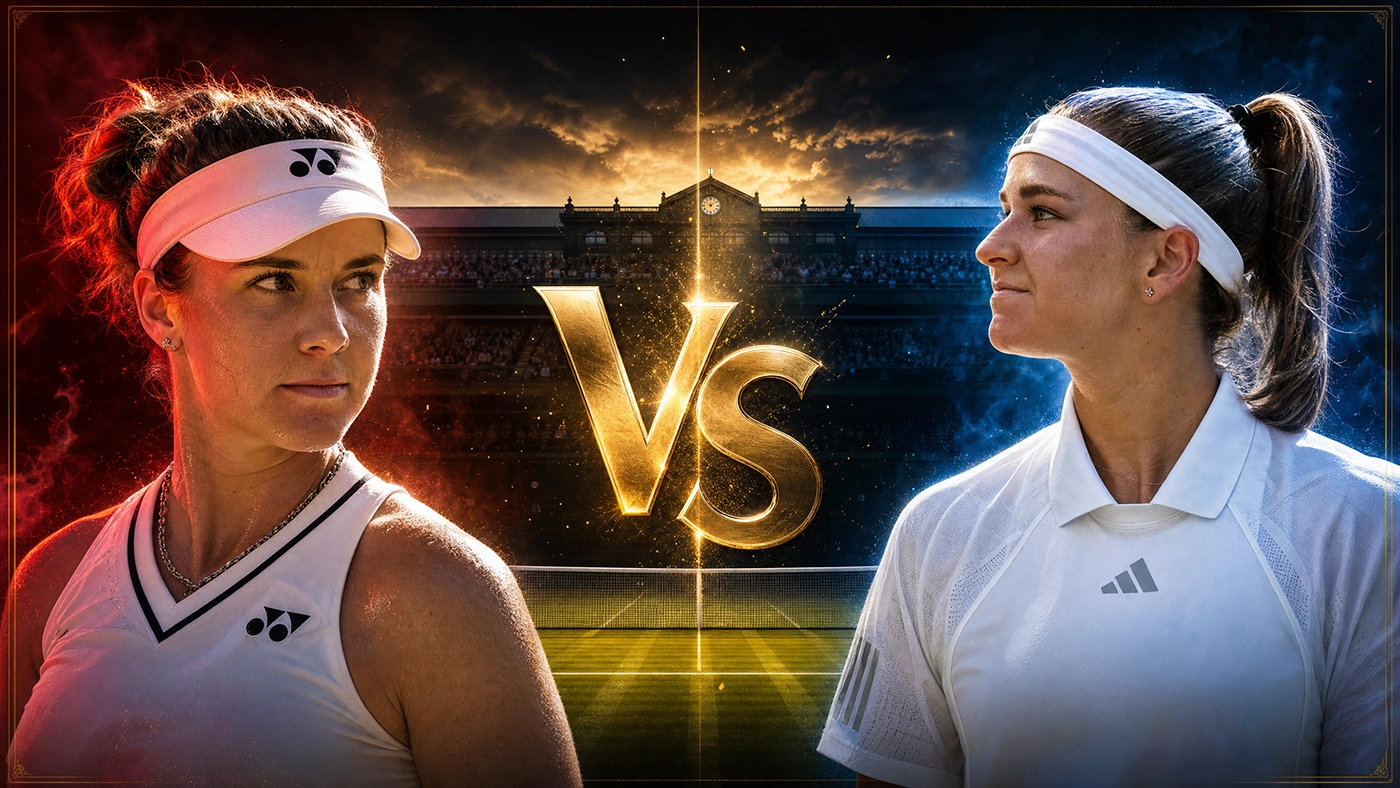
Karolina Muchova could not hold a fork. That was February 2024. Her right wrist, the one that generates the whip on her forehand and the bite on her slice, had just been operated on. A loose tendon, repaired. Six to ten weeks in a cast. She sat in her apartment in Prague and wondered whether she would ever play tennis again. She could not brush her teeth. She could not get out of bed without help. She was twenty-seven years old and her body had betrayed her.
Linda Noskova was burying her mother. That was June 2024. Ivana Noskova died on the thirtieth of June, one day before Wimbledon began, after a long battle with cancer. She was the woman who had left her job at a horse breeding station, managed the family budget on a railway dispatcher's salary, and spent four years driving her daughter to Switzerland to train with Martina Hingis's mother. Her final interview, in January, ended with a wish: she was looking forward to Wimbledon. She never made it. Linda played through her grief, won her first-round match against Sara Errani, and lost in the second round. She was nineteen.
On Saturday afternoon, these two women will walk onto Centre Court to contest the Wimbledon final. One could not lift a fork. The other played a tennis match with a grief she had no language for. Both are Czech. Both are chasing a first Grand Slam title. Only one will hold the Venus Rosewater Dish. PS3838 prices Muchova at 1.892. Noskova at 1.990. The market sees a coin-toss dressed as a tennis match. The market, for once, is about right.
PS3838 offers the sharpest lines on the Wimbledon final. Access them via AsianConnect88 →
Muchova: The artist who refused to break
There is nobody else like Karolina Muchova on the WTA Tour. That sentence gets thrown around, usually as hype. Here it is literal. Muchova hits a sliced backhand on roughly thirty percent of her backhands. The tour average hovers around fifteen. She charges the net nearly three times as often as Ash Barty did. She deploys drop shots, changes of pace, and spin variation the way a jazz pianist deploys chord substitutions, not because the sheet music demands it, but because she heard something the rest of the room missed. She has been called the tour's great shotmaker, the spiritual heir to Federer on the women's side, the player other players stop to watch. She has cited Federer herself as the inspiration: aggressive, attacking tennis, the net as a weapon, the realisation that power is not the only answer to power.
Her path to this final is the hardest any woman has walked at a Grand Slam this year. She beat Barbora Krejcikova, the defending Wimbledon champion, in the fourth round. She beat Naomi Osaka, four-time Grand Slam champion, in the quarter-final. She beat Coco Gauff, the 2023 US Open champion, in the semi-final. Three Grand Slam champions in three rounds. Against Gauff, she saved a match point at eight-nine in the deciding tiebreak. She won it twelve-ten. She is the fifth player in the Open Era to beat three Major champions in the second week of a Slam. The other four are Chris Evert, Serena Williams, Elena Rybakina, and Ons Jabeur. Good company.
The numbers behind the run are not normal. Muchova has won all her tiebreaks this tournament. She has not dropped an opening set. She won seventy percent of first-serve points against Gauff, a returner of Gauff's calibre. She arrives on a ten-match winning streak, her first double-digit streak of her career, having won Bad Homburg the week before Wimbledon. She is twenty-nine years old and playing the best tennis of her life, on a surface she is, and this is worth pausing on, allergic to.
Yes. Karolina Muchova is allergic to grass. She revealed this after her semi-final, casually, as if it were a footnote. She takes pills daily. Sprays. Eye drops. She carries what has been described as a medicine cabinet's worth of remedies just to compete on the sport's most hallowed surface. "Believe it or not," she said, "the reality is that yes, I am allergic to grass." A Czech, allergic to grass, in the Wimbledon final. There is a joke in here somewhere, but the Czechs stopped laughing at their grass-court dynasty years ago. Vondrousova in 2023. Krejcikova in 2024. Now Muchova or Noskova in 2026. Three Czech champions in four years. Martina Navratilova, nine-time champion, put it best: "Czech women are certainly pulling their weight at Wimbledon, I tell you. This is crazy good."
Noskova: The prodigy who grew up fast
Linda Noskova is twenty-one years old. She has the most grass-court wins on the WTA Tour since the start of 2025. This will be her first Grand Slam final. She has not looked remotely fazed by any of it.
Her path here was quieter than Muchova's, but it was no less impressive for it. Madison Keys, a US Open finalist, in the fourth round. Elise Mertens in the quarter-final, where Noskova won all eleven of her service games. Marta Kostyuk in the semi-final, seventy-nine minutes, nine of ten service games won. Noskova has dropped four sets across six matches, same as Muchova. She has hit thirty-two aces, averaging over six per match. Her first serve lands sixty-five percent of the time and wins seventy-three percent of those points. Those are not good numbers. Those are elite numbers, the kind that win Wimbledon titles.
The serve is her foundation, but it is no longer her only weapon. Noskova arrived on tour as a power hitter with a big delivery and not much else. Under coaches Tomas Krupa and Lukas Dlouhy, she has added drop shots, slices, and net play to her arsenal. She is no longer just hitting through opponents. She is constructing points. The transformation from ball-striker to tactician is not complete. She is twenty-one, it would be strange if it were. But the outlines are there. She won Berlin on grass last month, beating world number four Jessica Pegula in the final. She is not here by accident.
Then there is her mother. It is impossible to write about Linda Noskova without writing about Ivana, because Ivana's absence is the shape around which Linda's career has grown. Ivana sacrificed everything. The job. The budget. The four years of drives to Switzerland. In her final interview, she spoke about strawberries and cream at Wimbledon with the anticipation of someone who believed she would be there. Linda has spoken about her mother with a composure that feels almost impossible for someone her age. After receiving vicious online abuse about her late mother on Mother's Day in 2025, she addressed it directly, with grace and steel. She has said that her mother's memory is not a weight she carries. It is fuel. On Saturday, on Centre Court, the daughter of a railway dispatcher and a former stable hand from Vsetin will play for the Wimbledon title. The emotional physics of that moment are not something odds can capture.
The tactical equation
These two know each other. They are friends. They bonded at the Paris Olympics in 2024, where they played doubles together and nearly won a medal. They train together regularly. Noskova said after her semi-final: "Karolina is such a great fighter, such an incredible player, but mainly she is such a great person. I am glad I can play my first final against her." There is no manufactured edge here, no press-conference needle. Just two women from a country of ten million people, who have shared practice courts and Olympic village rooms, about to contest the biggest prize in tennis.
They have met once before. US Open third round, 2025. Muchova won in three sets: six-seven, six-four, six-two. She won seventy-two percent of first-serve points and converted five break points. The match was tight for two sets, then Muchova's variety pulled it away in the third. That is the pattern Noskova must break.
Muchova's path to victory runs through disruption. She will slice. She will change pace. She will draw Noskova forward and pass her, or draw her in and lob her. She will make the match feel awkward, because awkward is where Muchova thrives. Noskova wants rhythm. Muchova's job is to deny it. If Noskova is allowed to plant her feet and swing, the power differential tilts the match toward the younger woman. If Muchova can keep Noskova guessing, a drop shot here, a deep slice there, a sudden net rush on a big point, the emotional weight of a first Grand Slam final becomes harder to manage. Noskova has never felt what her body does in the second hour of a Grand Slam final. Muchova has. That matters.
Noskova's path runs through the serve. She must hold comfortably, because scoreboard pressure on Muchova's serve is the only reliable way to crack it. Muchova's delivery is good, not great. It is there to be attacked. Noskova's return game has improved this tournament, she broke Kostyuk four times in the semi-final, and she will need it. If Noskova can get into Muchova's service games early, force break points, and convert them, the match tilts. If she cannot, and Muchova settles into a serving rhythm, the variety game becomes a slow bleed.
The key number is sets. Muchova is twenty-nine and oh this year when winning the first set. Noskova has played three three-set matches this tournament. Both women have been stretched. Both have come through. The over two-point-five sets at 2.190 on PS3838 is the market saying this should be tight. It should be. Two players who know each other's games inside out, on the biggest stage either has faced, with a nation of ten million watching. Straight sets would be a surprise.
Where the value sits
PS3838 prices Muchova at 1.892 and Noskova at 1.990 on the moneyline. The set handicap has Muchova minus one and a half sets at 3.230, Noskova plus one and a half at 1.380. The games handicap is Muchova minus naught point five at 1.961, Noskova plus naught point five at 1.909. The total games line sits at twenty-three point five, with the over at 1.980 and the under at 1.884. The total sets market has over two point five at 2.190 and under at 1.729.
The moneyline is correctly tight. This is a genuine coin-toss match between two players at different stages of their careers but comparable levels on grass. Noskova has the bigger serve and the cleaner ball-striking. Muchova has the deeper toolbox and the weight of having been here before, or close to it. She played the 2023 Roland Garros final against Iga Swiatek and did not shrink. That experience, three years and one wrist surgery ago, is the intangible the market cannot fully price. Noskova has never walked through the clubhouse doors on final Saturday. Muchova has. At 1.892, in a match this close, that edge is enough.
My pick is Karolina Muchova to win at 1.892 on PS3838. The price is not a steal. It does not need to be. In a Wimbledon final between two first-time finalists, the player who has beaten three Grand Slam champions in three rounds and saved match point to get here, who has already felt what a Slam final does to the nervous system, warrants being a slightly stronger favourite than this line implies. Noskova's ceiling is higher than anyone she has faced this fortnight. But ceilings are theoretical. Experience is not.
The alternative position is over two point five sets at 2.190. Muchova has gone the distance twice in her last three matches. Noskova has played three three-set matches this tournament. Both won grass-court titles in three sets the week before Wimbledon. The format is familiar. The occasion is not, and finals between players who know each other this well tend to tighten rather than stretch. At 2.190, the market is offering a better price on three sets than the match dynamics justify. If you want a position on the match rather than the outcome, this is where to look.
Cian Murphy is a betting analyst and contributor at webetsmart. Read why he uses PS3838 →
Ready to bet the Wimbledon final? Open a PS3838 account via AsianConnect88 and access the same sharp lines Cian uses.
Odds referenced in this article were recorded for the original publication date and may no longer be available.